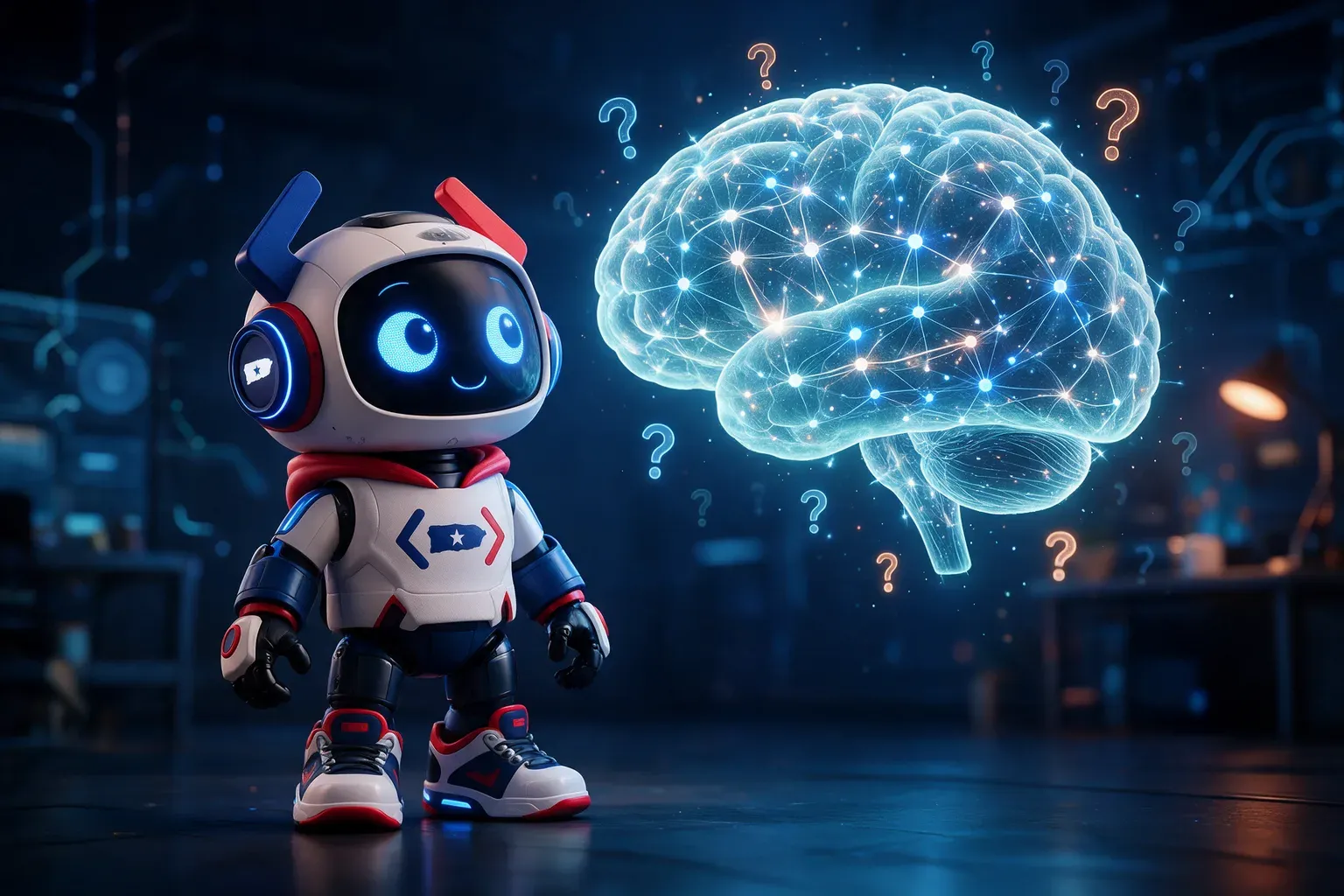
Everyone talks about AI. Almost no one can explain what it actually is.
It’s Not Magic. It’s Math.
Artificial intelligence is software that learns patterns from data and uses those patterns to make predictions or decisions.
That’s it. No consciousness. No feelings. No secret agenda. Just math running on a lot of hardware.
When you upload a photo and your phone recognizes your face, that’s AI. When Netflix recommends something you actually want to watch, that’s AI. When a chatbot answers your question in natural language, that’s AI.
A system trained on examples to recognize something it wasn’t explicitly programmed to handle. That’s the whole thing.
Three Building Blocks
Machine Learning is the foundation. Instead of writing rules by hand (“if the email contains ‘click here’, mark it as spam”), you feed the system thousands of labeled examples and let it figure out the rules itself. The rules emerge from the data, not from a programmer’s head.
Neural Networks are the architecture behind most modern AI. Loosely inspired by the brain: layers of nodes that transform input step by step until a pattern emerges. The more layers, the “deeper” the network. That’s where “deep learning” comes from.
Large Language Models (LLMs) like GPT, Claude, and Gemini are neural networks trained on massive amounts of text. They learn the statistical structure of language: what words tend to follow other words in what contexts. They don’t “understand” language the way you do. They predict what comes next, at scale, with remarkable accuracy. Different thing entirely, but the outputs look similar enough that the distinction gets blurry fast.
What AI Actually Is Not
AI is not thinking. It’s pattern matching.
It doesn’t know whether what it’s saying is true. It knows what sounds plausible based on training data. That’s why it can confidently tell you something completely wrong. We call it hallucination. Not a bug exactly, but a direct consequence of how the system works.
It doesn’t have goals. It optimizes for whatever objective it was trained on. Sometimes that aligns with what we actually want. Often it doesn’t, in subtle ways.
And it doesn’t learn in real time. The model you’re talking to today was frozen at some point in the past. Its “knowledge” is a snapshot.
Why Now
The ideas behind AI go back decades. What changed is three things: data, compute, and scale.
More training data than any previous generation had. GPUs powerful enough to train models with hundreds of billions of parameters. Architectures that scale cleanly with both.
That specific combination, not a single breakthrough, is what turned AI from an academic research topic into something running on your phone.
What Changes for You
If you’re a developer, this is already reshaping your day-to-day. Code completion, test generation, documentation, exploring architectural options. Not future use cases, today’s. I’m not talking about chatbots you query occasionally. I mean tools integrated into the flow of actual work.
If you’re not a developer, it still applies. Writing, research, analysis, customer interactions. The tools are everywhere now, whether you opted in or not.
Knowing how the system actually works doesn’t make you immune to the hype. But it makes you a better judge of when to trust the output, when to push back, and when to discard it entirely. That filter is worth more than any specific tool.
What’s your biggest question about AI? Drop it in the comments. I’ll answer it in the next post.